
Introduction
Keeping coral, fish, and invertebrates is no easy feat, but it is only as difficult as you make it. There is a steep learning curve, but with properly placed prioritization and guidance, it is an exciting journey. There is not one correct way to run a reef tank, however, there are definitely very wrong ways. We live in a time when there is an overwhelming amount of information, and generally there is more misinformation than useful and accurate information. However easy as it sounds, doing research takes skill. It takes practice to sort through and interpret the millions of sentences to know which ones to listen to and which ones to ignore. However, the more research you do, the better you will get at it. This isn’t meant to teach you how to do research but is meant to be the result of good research. A treasure chest, if you will. When I first started, it would have been very useful to have one single encyclopedia or cheat sheet. You might ask, why should I trust you or believe anything you have to say? What if you are just another one of these sources of misinformation and nonsense? My response to this is, “Good job, you are getting it!” Being skeptical of everything you read and hear is one of the best things you can do in reefkeeping. I am not an expert, and others are more knowledgeable about certain topics, but I will definitely point you in a successful direction.
A reefkeeper’s resume is their tank. There are times where one’s experience in reefkeeping has no correlation with knowledge or understanding of marine systems. I have seen and heard people who have been doing this for twice as long as me and still have an ugly tank with unhappy animals. As a beginner, it can be hard to differentiate between a healthy-looking tank and a not-so-healthy-looking tank. In reefkeeping, quality sometimes outweighs quantity, so if you’re skeptical, ask to see their tank. If it’s something you’d have in your house, it’s worth listening to what they say. Again, there is not one correct way to reef-keep, but talking to people who know what they’re doing and are successful at growing these animals is the best way to learn. People often advise picking one technique and sticking to it, but I have had the most success by combining tidbits from different methods into one that works for me. What works for me may not work for you given the time, effort, and money you are willing to spend in this. I am going to describe the methods I have adopted and why they work for me. I encourage you to pick and choose what to adopt and what to abandon when it comes to my methods and others’. There are many resources I have found valuable in my career. The most valuable resource for me is books. Reading “The Reef Aquarium,” Vol. 1 and Vol. 3, by Julian Sprung and Charles Delbeek, is essential for any reef-keeper. I recommend using this as a textbook reference and using it to search up any topic you need a refresher or deeper explanation on. Annotate this and mark it up. Write your ideas on it. These books are quite dated; the technology and methods from this era are somewhat rudimentary, but the basics of aquarium-keeping discussed in these books will never change. YouTube is also another great resource. Anyone can hit record on a camera and talk about their reef tank. Don’t believe everything you see. If someone has an unattractive tank and is telling you that a certain product or additive has changed their tank, be skeptical because they are getting paid to endorse that product. Again, their tank is their resume, and if they are standing in front of an unattractive aquarium, should you really be listening to what they have to say? I learned most of what I know from YouTube. Watching BRS’ 52 weeks of reefing with Ryan Batcheller is mandatory if you are keeping corals. Listen to this on your drives, at work, or before going to bed when you are doom scrolling. Jake Adams (Reefbuilders), Dong Zou (AcroGarden), Keith Berkelhamer (Reefbum), and Abe Tirona (Coral Euphoria) are more excellent reef media sources. There is too much information and knowledge out there to not be successful in reef-keeping. The turnover rate in reef-keeping is high because the amount of quality research and learning is inverse. Since this is a hobby to most people, most people will approach this as any other hobby and underestimate the steep learning curve. But you won’t because you are reading this. You understand the amount of time and effort required to be successful in keeping reef animals.
Starting a tank
The Nitrogen Cycle
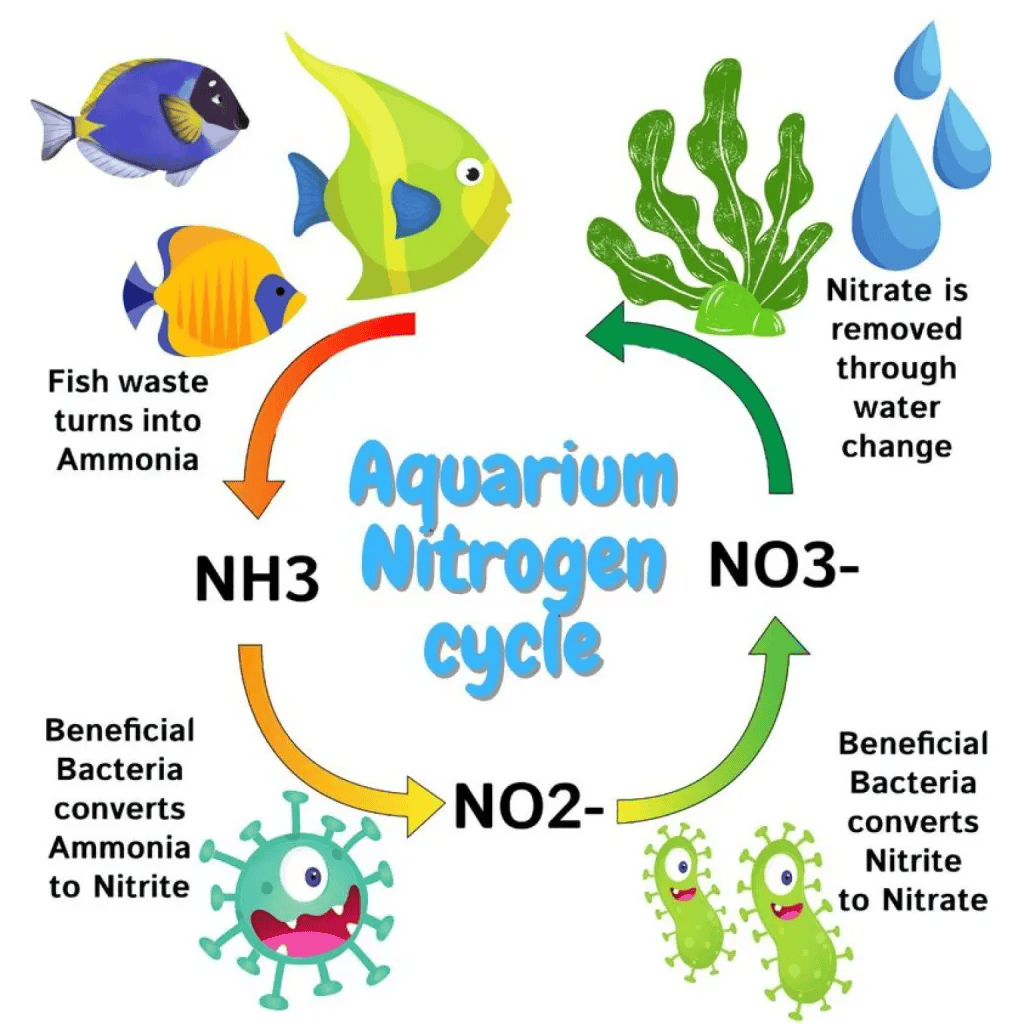
Understanding the nitrogen cycle is another prerequisite to owning any saltwater or freshwater aquarium. This biological process allows everything in your tank to be alive. This process is not restricted to aquatic environments and is also important in terrestrial systems. To start, an aquarium is a closed system. It is a box of water with no external, new water flowing through it. Since we want to keep animals in this box, this important biological process needs to be established to support such life. The base or starting point of the nitrogen cycle is ammonia (NH₃). Ammonia is created when anything living excretes waste and breathes and when anything alive dies and starts decaying. Ammonia is toxic to animals even in trace amounts. It binds to hemoglobin (blood) and prevents oxygen from being uptaken. It also affects nervous system performance. Since these breathing, pooping animals are being kept in a box with no continuous external water flowing, this ammonia level will build up and kill all the animals if the nitrogen cycle isn’t established. The first step in the nitrogen cycle is converting this toxic ammonia to a less-toxic form called nitrite (NO₂). This process doesn’t happen on its own and is facilitated by bacteria. A specific group of microbes oxidizes (removes an electron) ammonia to convert it into nitrite. A different group of bacteria will then convert this slightly less toxic form of nitrogen into a much less toxic form called nitrate (NO₃). Nitrate is not toxic in trace amounts but can be toxic if it’s allowed to build up in an aquarium (Stein and Klotz, 2016). In summary, this process converts toxic compounds created by every animal into less toxic, manageable compounds and is essential for housing any life in a closed system.
Planning a tank
Understanding the importance of saltwater aquariums and the nitrogen cycle are the first steps to owning a tank. Once you have a grasp on these, that’s when the real fun starts.
Setting up your first or 10th saltwater tank takes much consideration. Space, time, and budget are the largest considerations. Planning where you will put the tank is obvious, but I recommend you put it in a place where you and whoever you live with will see it every day. This way, you are less likely to neglect it and will spend more time observing your animals. It also makes sense to put the tank in an area where a sink, toilet, or any sort of drain is nearby. This makes water changes and cleanup much easier. The ergonomics of a tank will make or break the quality and quantity of maintenance performed, which will end up making or breaking the health of the system.
Another not-so obvious aspect to planning a tank is the amount of time you are willing to dedicate to this tank. An aquarium is not impossible and does not have to be a part-time job if you don’t want it to be. I don’t recommend getting a massive tank if you have a family and a full-time job and cannot see yourself committing a few hours a week to taking care of the tank. The looks and health of the system will be a reflection of the time and attention put into it. A common misconception about starting a tank is that the smaller the tank, the more difficult it will be. Many people will say “go the biggest you can” when starting your first tank. It is true a smaller tank will have less margin for error and is prone to larger water chemistry swings. However, in my experience, a smaller tank is less intimidating, cheaper, and easier to maintain. This is why I recommend a 20-gallon tank for a beginner saltwater aquarist. The best size is 20 gallons since a 5-gallon water change once a week is quick, easy, inexpensive, and effective in a tank that size. A 25% water change will solve almost every problem in any tank. A tank this size will allow you to understand the basics successfully and inexpensively. In my experience, a tank smaller than 20 gallons becomes easy to neglect and is less beginner-friendly. A tank larger than 20 gallons is definitely more beginner-friendly, but a higher cost and effort are generally required to maintain an aquarium this size.
Budget is another massive consideration. There are almost too many options, technologies, accessories, and additives for saltwater aquariums. This is daunting for anyone stepping into keeping a reef tank. My advice to anyone overwhelmed with the abundance of options is to ask, “Why?” Keeping your techniques and equipment simple goes a lot further than making things complicated. You need to know how your actions are affecting your animals. Ask, “Why am I adding this?” before dosing any supplement and “How does this piece of equipment benefit my animals?” before making a large purchase. Keeping it simple is cheaper, easier, and has fewer points of failure.

